Work

She Lies Down Like a Woolen Thread

An acousmatic composition built entirely from the soundscape of a small walled town, recorded over the three days of a festival that had taken its streets. This page documents how it was made, from eight hours of field recordings to a piece that ends where no microphone had been.

Acousmatic composition, fixed media, stereo · recordings 2018, composition 2019 · 9′26″

She Lies Down Like a Woolen Thread

9′26″ · stereo · 44.1 kHz

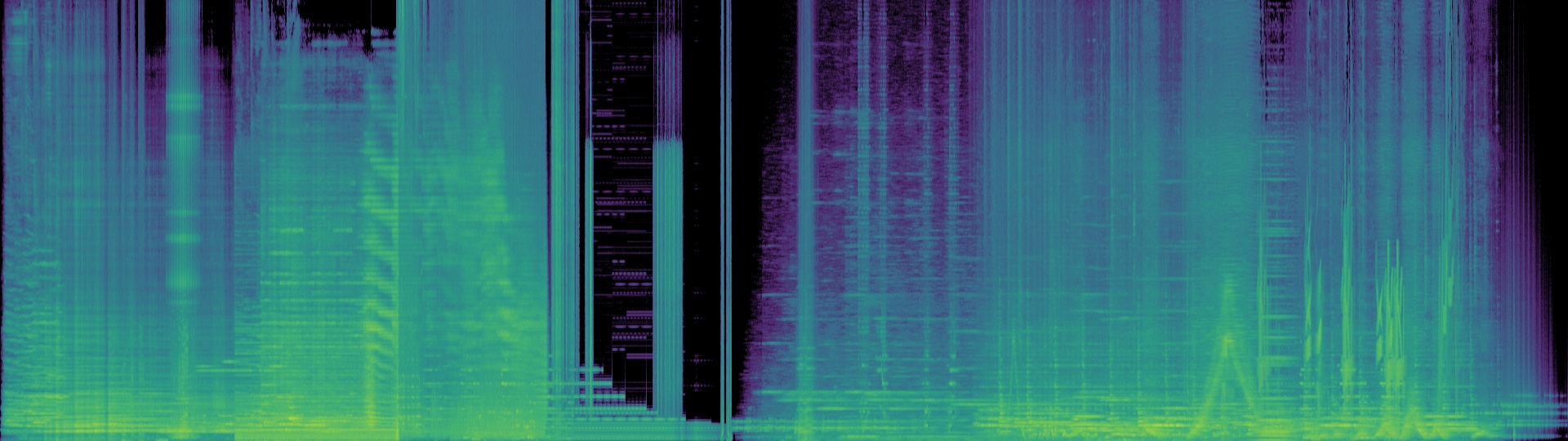
Spectrogram of the complete piece, showing a dense first part, a long thinning in the middle and a second growth.
The piece, seen. Spectrogram of the complete work, logarithmic frequency scale to 16 kHz. The three movements are visible as they are heard, a dense first part, a long thinning around the middle, a second growth that never returns to the density of the opening.

What survives of a place when its sounds stop being recognisable

For three days in May 2018 the walled town of Sarzana, in Liguria, filled with sound. A festival had taken over its historic centre, and music was happening in courtyards, porticoes and squares that people usually cross in silence. The recording campaign ran across those three days, and what interested me was never the concerts. It was everything around them, the setting up, the waiting, the footsteps of people arriving, the bells, the applause reaching from a street away, the laughter, the fragments of conversation a microphone catches without meaning to. Ninety-six recordings came out of it, eight hours and five minutes of a town that had changed its acoustic identity for a weekend.

The composition began the following year, and it started from one question.

What survives of a place once its sounds stop being recognisable?

The spectral work was done inside AudioSculpt, the IRCAM editor. Recordings were taken apart into partials and rebuilt from them, filtered through the spectral image of other sounds, transposed, time stretched and cross-synthesised, until a bell became a texture and a voice became a colour. The decision that shaped everything was to stay in the moment just before the source disappears. Fragments stay identifiable for a second or two, then dissolve. A listener recognises something familiar and loses it again, and that recognition and loss is what the piece is made of.

The form is in three movements. A dense first part, saturated with the town. A long thinning from around three and a half minutes, where nearly everything is taken away and what remains is barely above the noise floor. Then a second growth, on material that has travelled further from its origin.

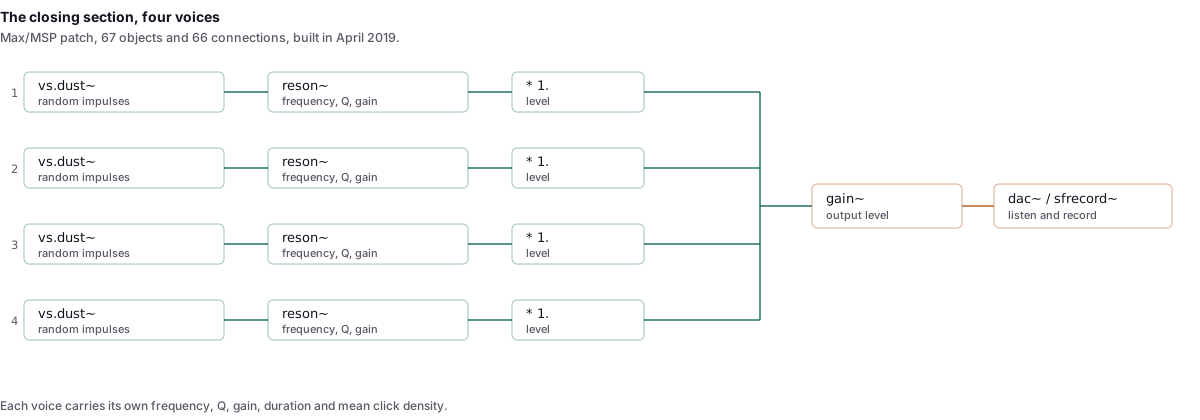
The last section leaves the recordings behind. Four resonant filters, excited by randomised impulse trains, build a synthetic resonance that is no longer the town but holds its shape. The piece ends in a place the microphones had never been.
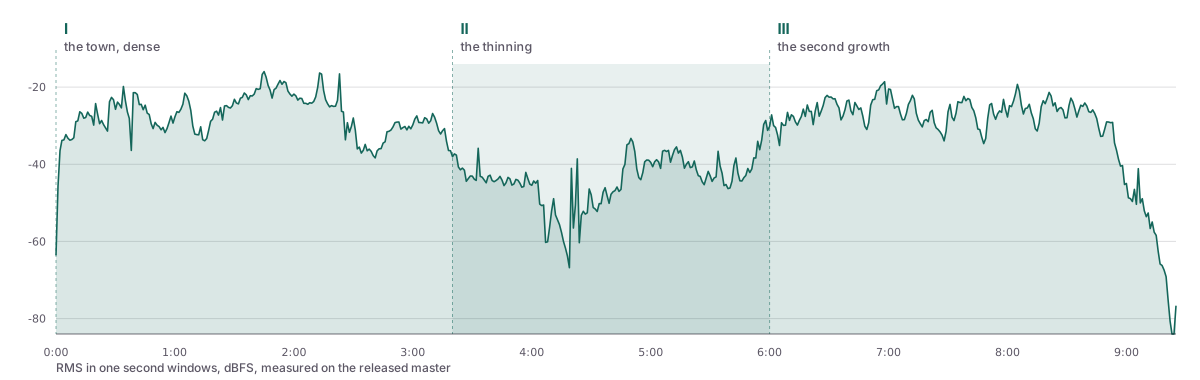
Energy profile of the piece in one second windows, with the three movements marked.
The form, measured. RMS energy of the released master in one second windows. The boundaries of the three movements fall around 3′20″ and 6′00″, and they match the sections annotated by hand on the sonogram in 2019.

Technical details

Title
She Lies Down Like a Woolen Thread
Year
Recordings 2018, composition 2019
Medium
Acousmatic composition, fixed media, stereo
Materials
Field recordings made in the historic centre of Sarzana, Italy, across the three days of the XVIII Musica e Suoni festival, 4 to 6 May 2018. Ninety-six recordings, eight hours and five minutes, 44.1 kHz, 16 and 24 bit stereo. Voices in passing, applause, bells, laughter, footsteps, fragments of conversation, the sound of a town being set up for a festival.
Dimensions
Duration 9 minutes 26 seconds. Stereo, 44.1 kHz. Fixed media, for loudspeaker diffusion or headphones.
Tools and software
  • Zoom H4n, field recording.
  • Logic Pro X and Audacity, selection and editing of the corpus.
  • IRCAM AudioSculpt 3, the whole spectral stage. Partial tracking analysis, synthesis from partials, generalized cross synthesis, image filter, transposition, time stretching, filtering, gain envelopes.
  • Max/MSP, closing section. Four resonant filters excited by randomised impulse trains, each voice with its own frequency, Q, gain, duration and mean click density.
  • Logic Pro X, final montage. Convolution reverb with Space Designer, compression, pitch shifting, delay.
On artificial intelligence
The work was made in 2018 and 2019 with the spectral tools listed above. No generative or AI-based processing was involved at any stage.
Release
Released digitally in 2019. Remastered edition, Green Cat Records, 2022.

From eight hours of a town to nine minutes of sound

Everything shown here comes from the working archive of the piece, the recordings as they came off the memory cards, the screenshots taken while the spectral work was being done, the patch written for the closing section.

Three days with the recorders

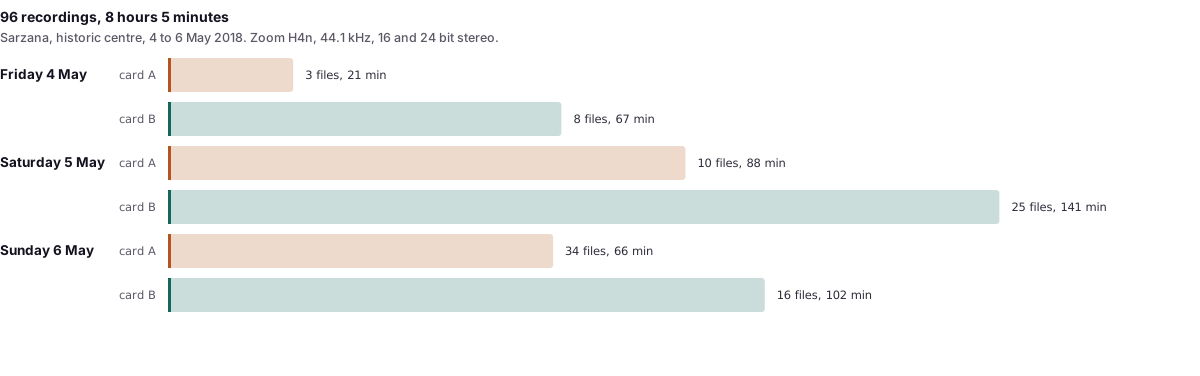
The town was recorded continuously across the three days of the festival, in the streets, courtyards and porticoes of the historic centre, on a Zoom H4n. Two memory cards came back full. What was collected was the festival as a sound environment rather than as a series of concerts, which is why the busiest recordings are the ones made between events.

The recording campaign, three days and two memory cards, with number of files and minutes.
The corpus. Ninety-six recordings, eight hours and five minutes, measured on the archived cards.

Listening back, and cutting

The corpus was listened through and reduced to the fragments worth keeping, using Logic Pro X and Audacity. The criterion was never sound quality. It was whether a fragment still carried the town in it after being taken out of its context, which is something you only find out by listening to it alone.

Taking the sound apart in AudioSculpt

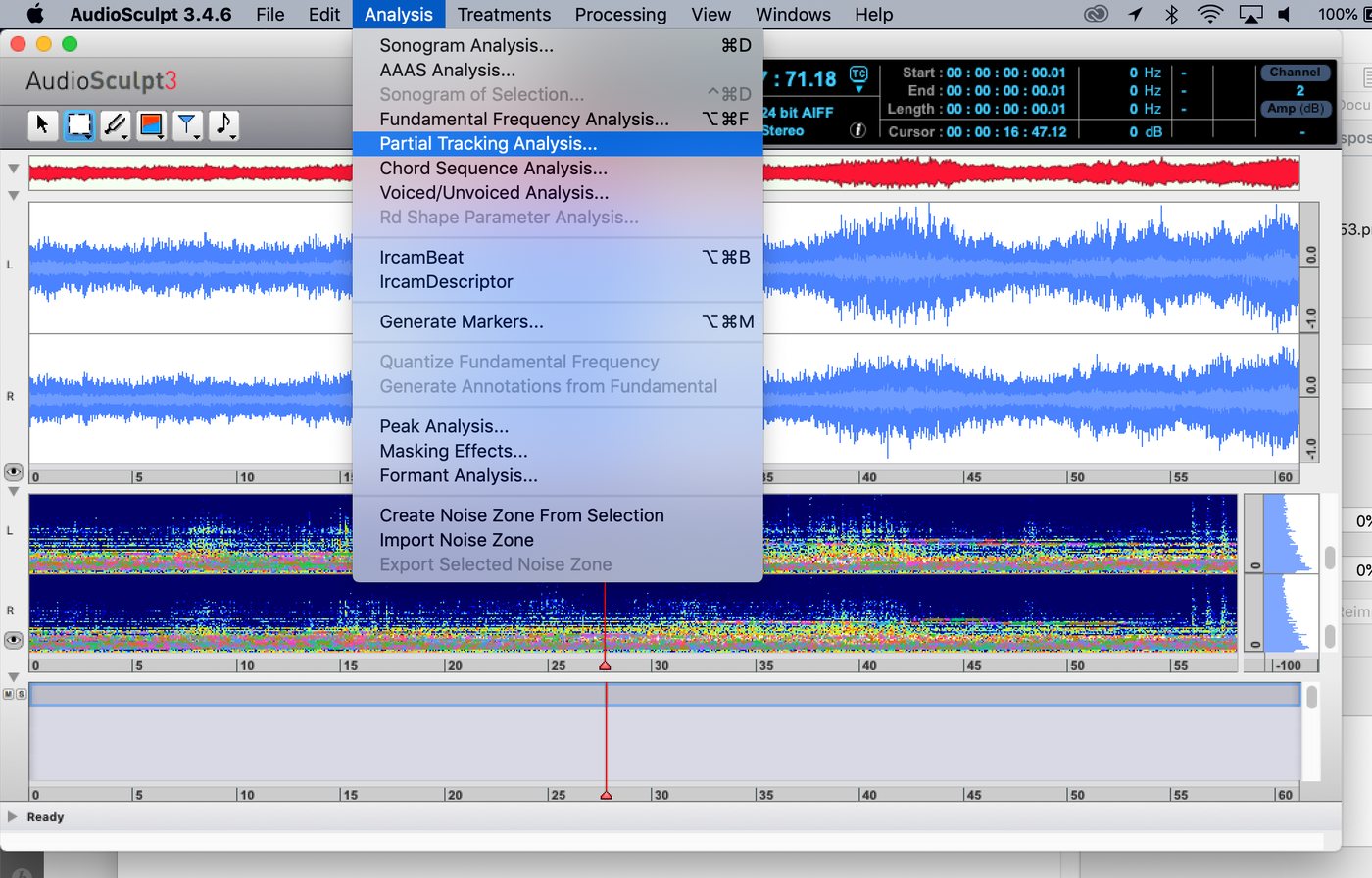
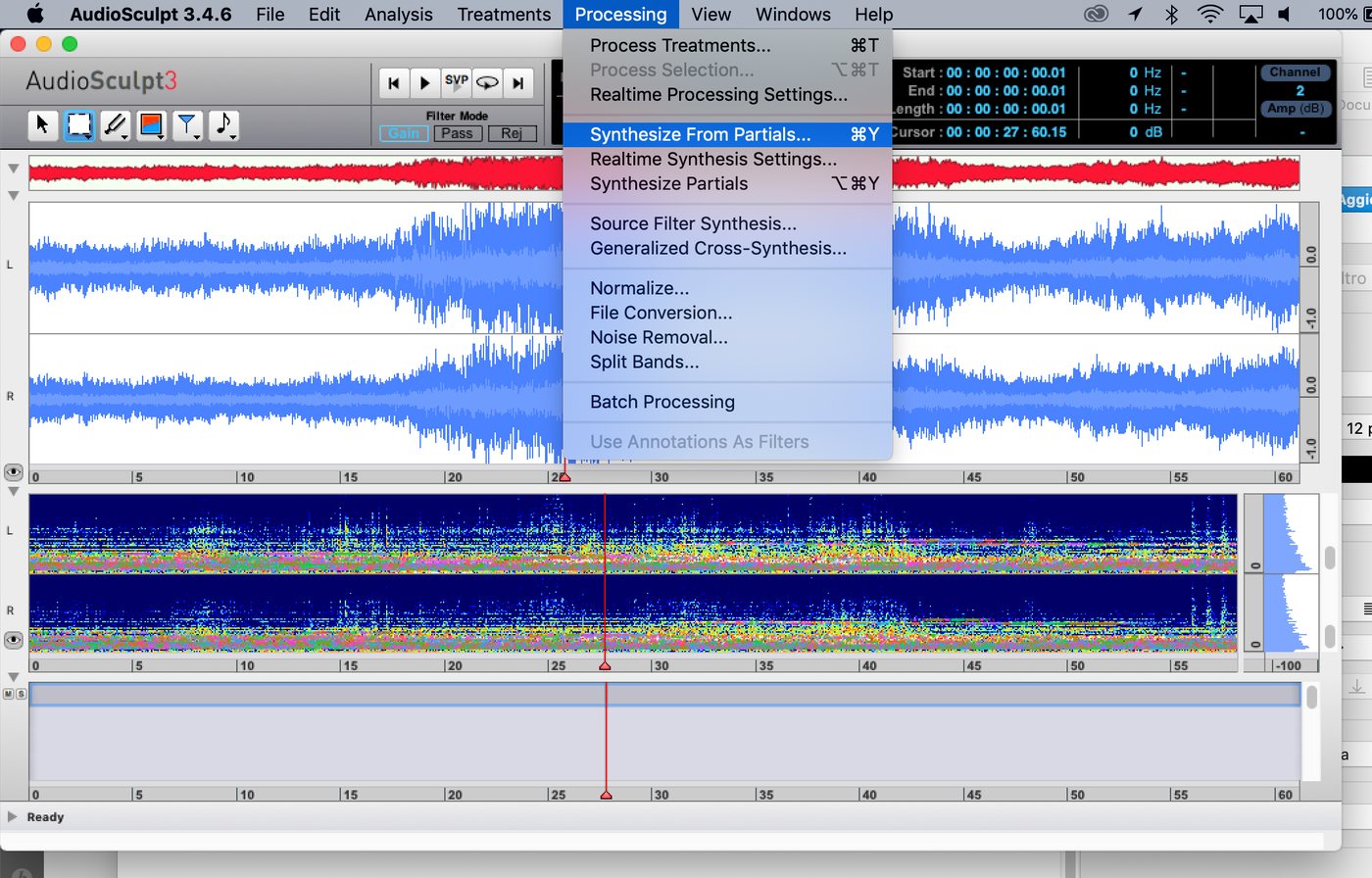
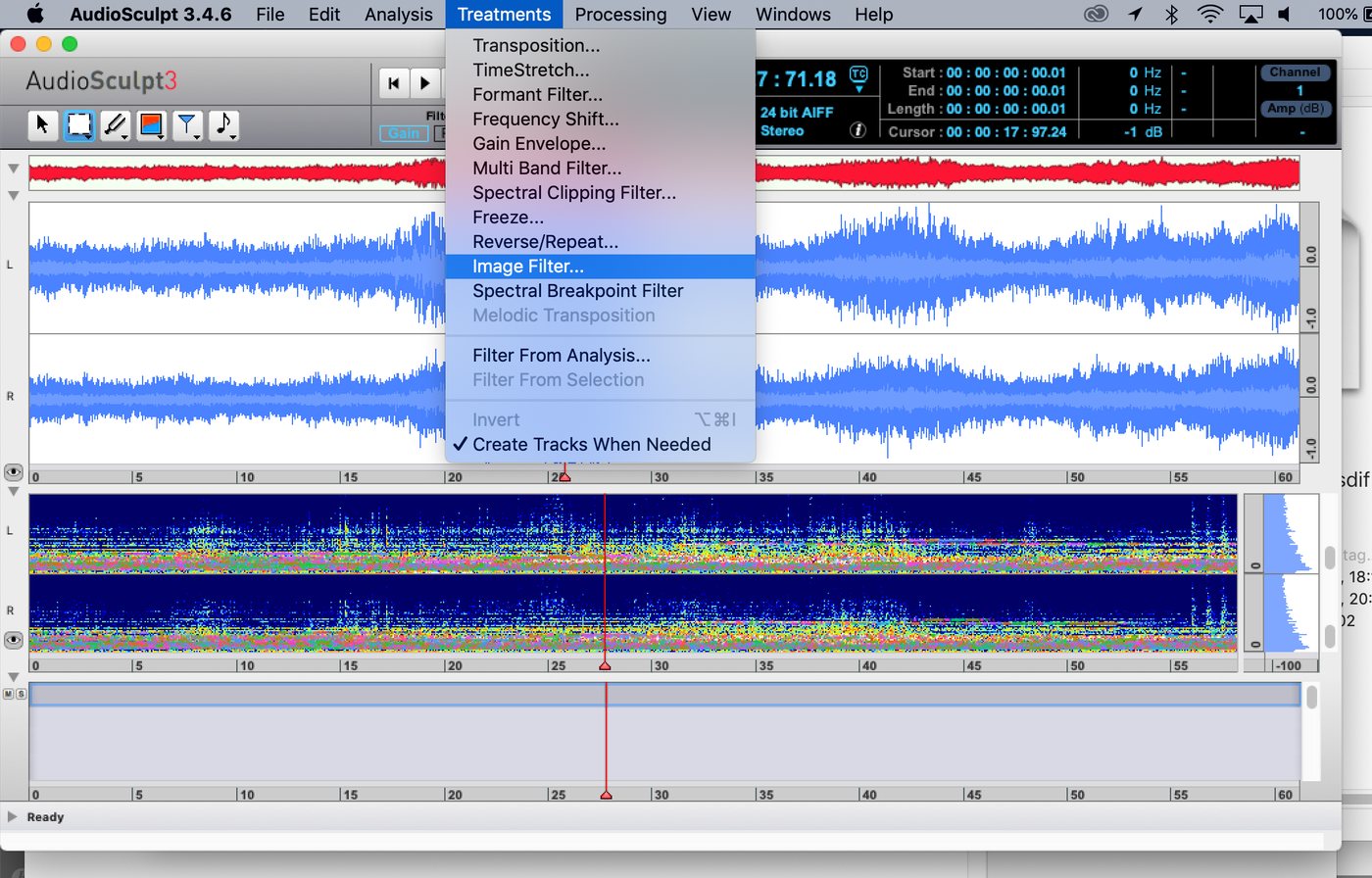
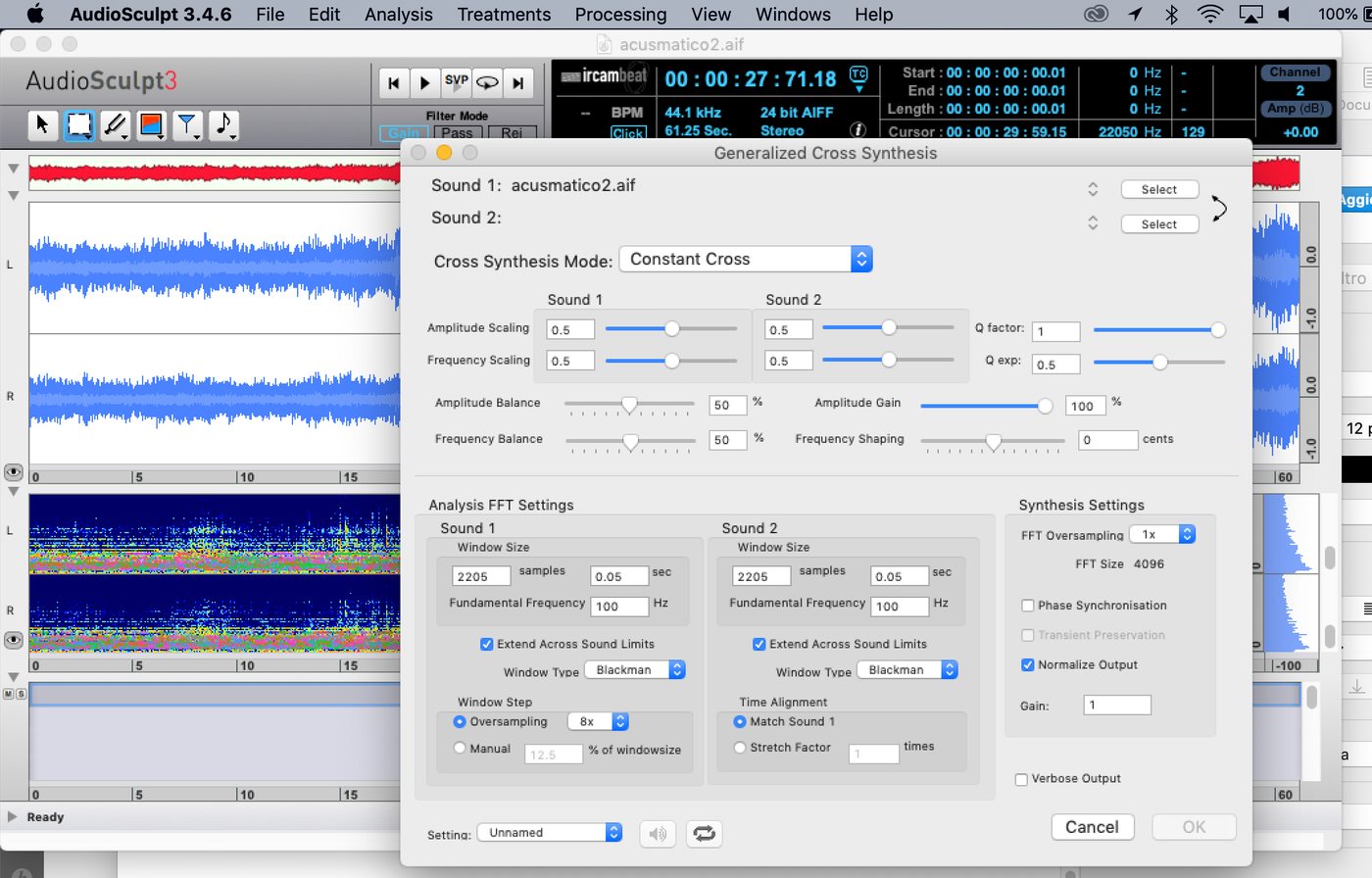
The spectral stage was done in AudioSculpt 3, the IRCAM editor. Each fragment was analysed, decomposed and rebuilt. Partial tracking analysis first, to find the lines inside a sound, then synthesis from those partials alone, which keeps the shape of a sound and throws away its body. The image filter takes the sonogram of one recording and uses it as a filter over another, so a bell can be heard through the spectrum of a crowd. Generalized cross synthesis crosses two sounds into a third that belongs to neither.

The screenshots below were taken during that work in 2019. They are the working documents of the piece, kept as they were.

AudioSculpt, the Analysis menu with Partial Tracking Analysis selected over a sonogram.
Partial tracking analysis. Finding the individual partials inside a recorded fragment.
AudioSculpt, the Processing menu with Synthesize From Partials selected.
Synthesis from partials. Rebuilding the fragment from its partials alone, which keeps its shape and loses its body.
AudioSculpt, the Treatments menu with Image Filter selected.
Image filter. The sonogram of one sound used as a filter over another.
AudioSculpt, the Generalized Cross Synthesis dialog with its parameters.
Generalized cross synthesis. Two sounds crossed into a third, with the analysis window at 2205 samples and a Blackman window.

Finding the form on the sonogram

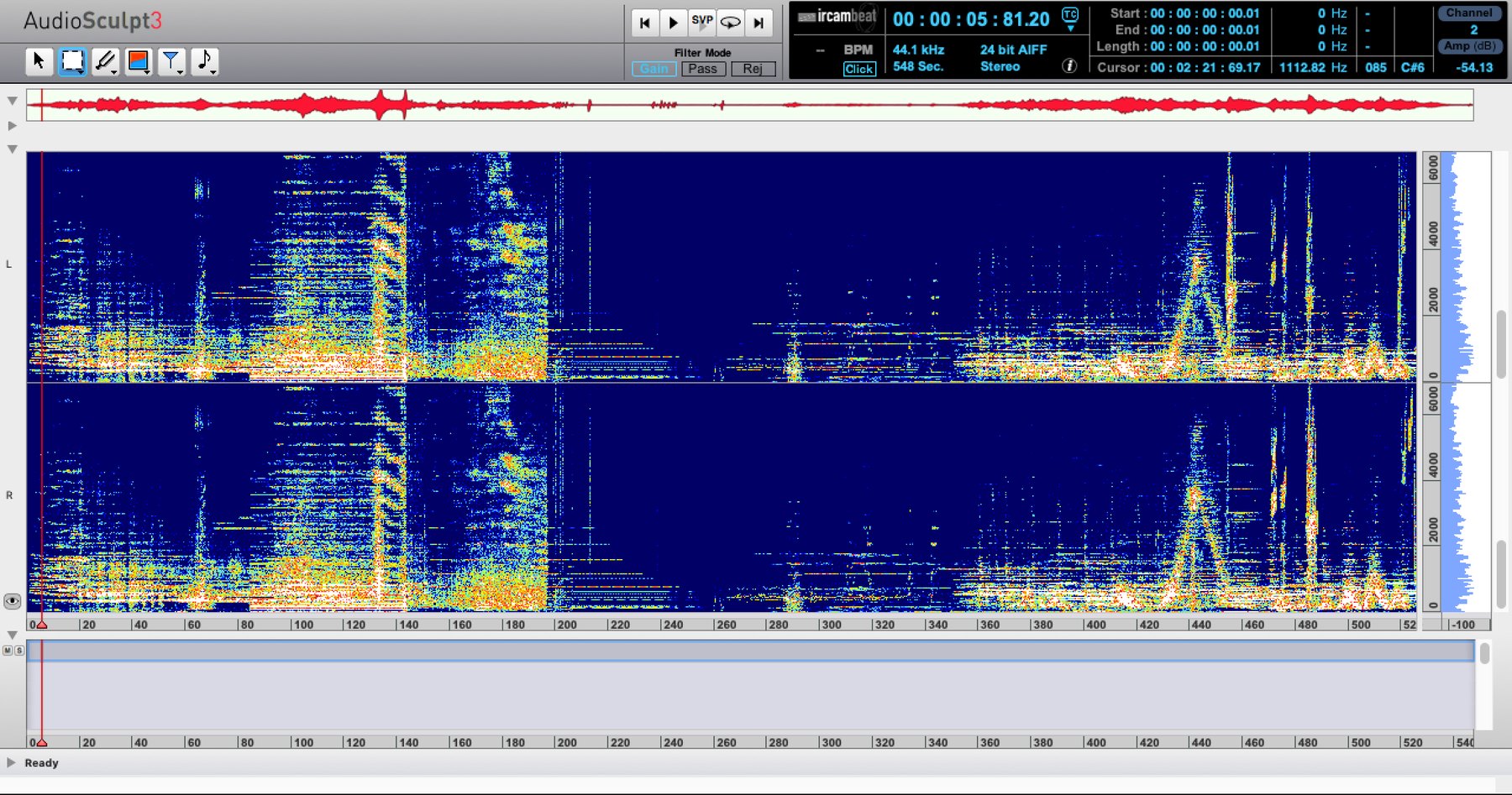
The three movements were decided by looking at the whole piece at once. The sonogram below is the one used at the time, with the sections marked by hand over it. The long thinning in the middle was the hardest decision of the piece, because it asks a listener to stay with almost nothing for more than two minutes.

AudioSculpt showing the sonogram of the whole piece, 548 seconds, stereo.
The whole piece in one view. AudioSculpt 3, sonogram of the complete work, 548 seconds, 44.1 kHz, 24 bit AIFF. The empty band between roughly 200 and 275 seconds is the thinning.

The closing section, written in Max

The last minutes leave the recordings behind. A patch written in April 2019 drives four resonant filters, each excited by a train of random impulses whose mean density is set by hand. Frequency, Q, gain and duration are separate per voice, so the four resonances can be tuned against each other until they stop sounding like filters and start sounding like a room. Nothing of the town is left in this material, and yet it has its proportions.

Signal flow of the closing section, four voices of random impulses into resonant filters, summed to the output.
The closing patch. Signal flow read from the original Max file, 67 objects and 66 connections.

The montage

The final assembly was done in Logic Pro X, with convolution reverb, compression, pitch shifting and delay used to place the transformed material in a single acoustic space. The piece was finished in June 2019 and released digitally that year.

Francesco Mariano

Francesco Mariano (Modena, Italy, 1973) is an electroacoustic composer and sound artist based on the Apuan coast of Tuscany. His practice begins in the field, with microphones and time, and moves through structured listening into composition.

He holds a second-level Academic Diploma in Electronic Music from the Conservatory of Piacenza and a second-level university Master in Film and Videogame Music Composition from the University of Rome Tor Vergata, with a specialisation in artificial intelligence applied to audio signals. He teaches Ear Training for Sound Engineering at the "G. B. Martini" Conservatory of Bologna and Sound-Space Design at the Academy of Fine Arts of Macerata. His works are released by Green Cat Records and DK Records.

He is the author of Soundscape Annotation, an open-access methodology for structured soundscape annotation, and of an open-source machine-listening toolkit. In 2026 he was selected, among five artists from more than 250 applications, for the zero edition of the Biennale del Gran Sasso, and his generative work Terra Viva was presented at the European Space Agency sustainability conference at ESA-ESRIN, Frascati.

She Lies Down Like a Woolen Thread. Acousmatic composition by Francesco Mariano, 9′26″, stereo. Field recordings made in Sarzana, Italy, 4 to 6 May 2018. Composed in 2019. Released digitally in 2019, remastered edition Green Cat Records, 2022. Figures on this page were measured on the released master and on the original working files. Screenshots are the working documents of 2019.